
GA 4 Court Release Paths
Waterbury Superior Court at Geographical Area No. 4 handles Waterbury-area criminal and motor vehicle matters. A person brought to court may leave judicial marshal control for the community under a bond or promise, or may return to police or CT DOC custody. The court can also enter a dismissal, nolle, sentence, or other order that changes the legal basis for detention. A nolle means the prosecutor will not proceed with the charge at that time, subject to Connecticut law and the case record.
Physical exit from a courthouse is only one possible path. Remand means the court directs continued custody. A person remanded after arraignment may enter CT DOC, often through a correctional center serving Waterbury courts. A transfer to state custody is not release. The docket and order identify the legal path, while the receiving agency's records show where the person actually went.
Confirm GA 4 Release Orders
Begin with the case, not an assumed jail. Connecticut's pending criminal and motor vehicle lookup can show open-case information, while the convictions lookup covers dispositions in its scope. Search results may not reproduce the full order, so the clerk remains the official route for documents.
- Gather the person's full name, date of birth if appropriate, arrest date, docket number, and the Waterbury arresting agency.
- Search the official pending-case lookup and, when relevant, the criminal and motor vehicle convictions lookup.
- Read docket entries for bond, promise to appear, dismissal, nolle, sentence, time served, mittimus change, or another release-related order.
- Ask the GA 4 clerk for the docket, bond or release order, mittimus, disposition, and sentence record if the online entry lacks needed detail.
- Confirm physical custody with Waterbury Police or CT DOC. Use CT SAVIN/VINE if the person entered covered state custody.
A court entry can explain legal authority without documenting the exact moment a person left an agency's control. Conversely, a VINE change can report status without giving the legal reason. Use both when the question crosses court and correction records. The Waterbury County released inmates lookup gives the full source order.
Note: A future court date may follow a lawful release and does not mean the person remains in courthouse or correctional custody.
GA 4 Release Records Contact
Waterbury GA 4 is the relevant courthouse for local criminal and motor vehicle work described in the research. Contact the clerk for the court file. Do not ask the courthouse to produce Waterbury Police arrest paperwork or a CT DOC movement history because those records belong to the agencies that created them.
Waterbury Superior Court / GA 4
400 Grand Street
Waterbury, CT 06702
Clerk phone: 203-236-8100
Criminal and motor vehicle matters
A precise clerk request names the person and docket, identifies the document, and explains whether an ordinary or certified copy is needed. Useful items include docket entries, a bond order, release order, mittimus, plea and sentence record, or disposition. Certification may matter for a legal filing, while an ordinary copy may be enough for personal verification. Ask the clerk about any current copy or certification cost.
When requesting a time line, state the court date and the custody question. For example, ask for records showing the bond set or changed at a named appearance, the order directing release or remand, and the resulting mittimus. Avoid asking the clerk for a general “inmate file.” GA 4 creates court records, while judicial marshals, police, and CT DOC maintain their respective custody records.
The Waterbury Judicial District also has functions at 300 Grand Street, including civil and family work. Do not confuse that address with the GA 4 criminal and motor vehicle location mapped for this custody page.
GA 4 Judicial Custody Role
Judicial marshals control courthouse detention for court proceedings. That custody is tied to production before the court, safety, and execution of court directions. It should not be described as a city jail, county jail, or state correctional institution. No long-term GA 4 inmate roster exists in the mapped sources.
The Connecticut Judicial Branch pending-case lookup is the most direct online starting point for a current Waterbury criminal or motor vehicle matter.
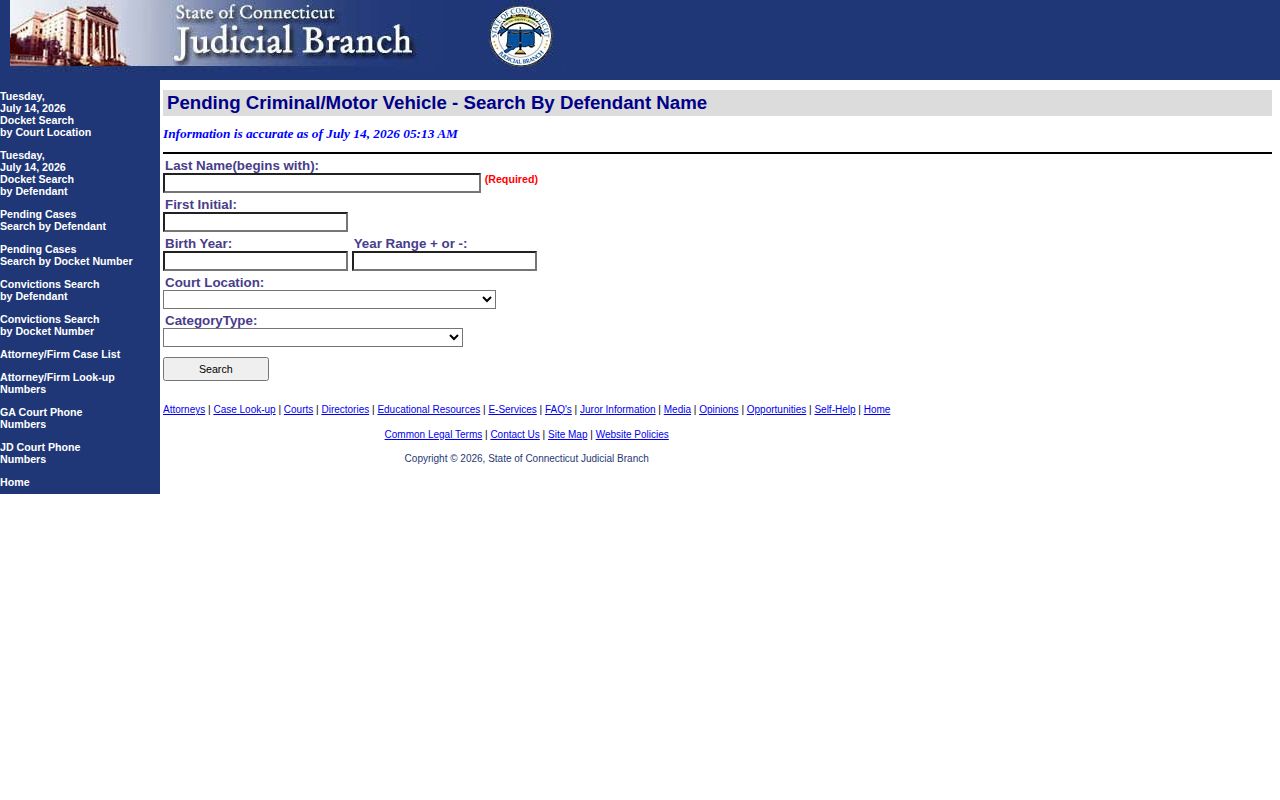
The search interface can identify a case and docket trail, but the actual court order controls. Use the clerk when the screen does not contain the release, bond, mittimus, or sentence detail needed.
- Bond
- A financial or nonfinancial release condition set under the case.
- Mittimus
- A court document directing custody or the execution of a sentence.
- Disposition
- The recorded outcome of a charge or case.
- Remand
- A direction that the person remain in or return to custody.
Pair GA 4 Release Records
No single record answers every release question. Court files show judicial action. Police files document the arrest and short local custody. CT DOC records show admission, location, movement, sentence dates, and discharge within the state correctional system. CT SAVIN/VINE adds status and notification information but is not the legal disposition or a full archive.
| Question | Primary source | Supporting source |
|---|---|---|
| Why did custody change? | GA 4 order or docket | Police or DOC custody record |
| Did police release the person? | Waterbury Police release paperwork | GA 4 bond and case entries |
| Was the person remanded? | GA 4 mittimus or order | CT DOC current search |
| When did state custody end? | CT DOC discharge record | Court sentence and VINE status |
Pair dates carefully. A judge can enter an order before physical processing finishes. State intake may post after transport. A later DOC release can arise from a different court event or sentence computation. Record the source beside each date rather than merging them into one unsupported timeline.
Sentence completion illustrates the difference. The court judgment states the sentence, but CT DOC calculates confinement credit, applicable earned credit, movements, detainers, and the completed discharge date. A time-served sentence may produce a rapid release order, while another sentence may require continued DOC processing. Obtain the judgment and DOC record when the exact end of state custody matters.
GA 4 Erased Release Records
A missing Waterbury court case does not always mean no court custody occurred. Connecticut erasure law, including Conn. Gen. Stat. Sec. 54-142a, can restrict access to eligible records. Clean Slate may erase some eligible convictions automatically or through a petition path, depending on the case and conviction date. Juvenile and sealed material also follows separate limits.
Conn. Gen. Stat. Sec. 1-215 excludes erased records from the public arrest-record definition. A clerk or agency may therefore be unable to disclose a record that once existed. Do not try to fill a public gap with guesses. Ask the originating office whether it can confirm that access is restricted, and rely only on records lawfully supplied.
Note: The absence of a public docket can reflect erasure or another restriction, not proof that an arrest or release never occurred.
Waterbury Court Release Structure
Waterbury searches often use county-jail language, but Connecticut divides the work differently. Municipal police make the local arrest. GA 4 handles the court action. CT DOC runs both state pretrial centers and sentenced institutions. This is why no sheriff roster can confirm a release ordered in the Waterbury courthouse.
Use GA 4 for legal cause and documents. Use Waterbury Police for a local arrest or direct release. Use CT DOC for state custody and discharge. BOP and ICE apply only when the case moves into their separate federal systems. Keeping those lines clear is especially important when someone leaves one authority and immediately enters another.
A detainer or another court matter can prevent an expected community release. The GA 4 order may resolve one case while a different authority keeps custody. Search the named case and ask whether another mittimus, warrant, or hold appears in the records that can be disclosed. Then confirm the receiving agency instead of assuming the courthouse order ended all custody.
A release from judicial marshal control can mean return to police, return to CT DOC, or departure to the community. The destination must be confirmed from the order and the next custodian's record.