
Waterbury Scheduled and Actual Release
A scheduled or estimated date is a calculation made before the person leaves custody. An actual release date records the completed event. The two can differ because credits, discipline, detainers, court changes, parole action, or a transfer can alter the path. Connecticut DOC uses three specific public field names: minimum release date, maximum release date, and estimated release date. None is the same as a court date, and none alone is a guarantee that the person will leave on that day.
Custody status must come first. New Haven Correctional Center houses mainly pretrial offenders and serves Waterbury courts. Someone marked accused or unsentenced does not yet have a final prison term from which a projected date can be calculated. Bond, dismissal, nolle, a release order, a detainer, or a later sentence can control what happens next. For that person, the Waterbury court docket may be more useful than the sentence-date fields.
After release, a person may stop appearing in the public current-custody search. That absence does not prove the release date. CT DOC Freedom of Information records, Connecticut VINE status, and the Waterbury court case can establish a fuller timeline. A transfer to another facility or agency also means the person left the first location without being released to the community.
Find a Waterbury Projected Release
The best route follows the custody source instead of a county jail assumption. Connecticut runs both pretrial correctional centers and sentenced prisons through CT DOC. Waterbury Police may release someone before state booking, while New Haven Correctional Center, Cheshire Correctional Institution, or another state facility may hold a person after court action. Federal and immigration cases use separate systems.
- Identify the arresting and holding agency. Use Waterbury Police and the Waterbury court for a short city hold; use CT DOC for state custody.
- Open the official CT DOC Inmate Search and follow its public-search link. Search by CT DOC number when known, or begin with the first letters of the last name.
- Match the full name, date of birth, inmate number, location, and accused or sentenced status. Do not rely on a name alone.
- For a sentenced person, record the minimum release date, maximum release date, and estimated release date. Also note any detainer and current facility.
- Check the Waterbury criminal case for the judgment and sentence. Add BOPP records only when parole eligibility or a hearing affects the expected date.
- If the person is no longer displayed, request CT DOC records sufficient to show admission, movement, release or discharge date, and release type.
The Waterbury County release search gives the broader police, court, state, federal, and immigration fallback when the custody source is uncertain. A current CT DOC result means state custody. A court case can show why release may occur. A VINE change can signal that a reporting agency released the person, but it does not replace the legal disposition.
The CT DOC search landing page is the official route to the state inmate lookup:
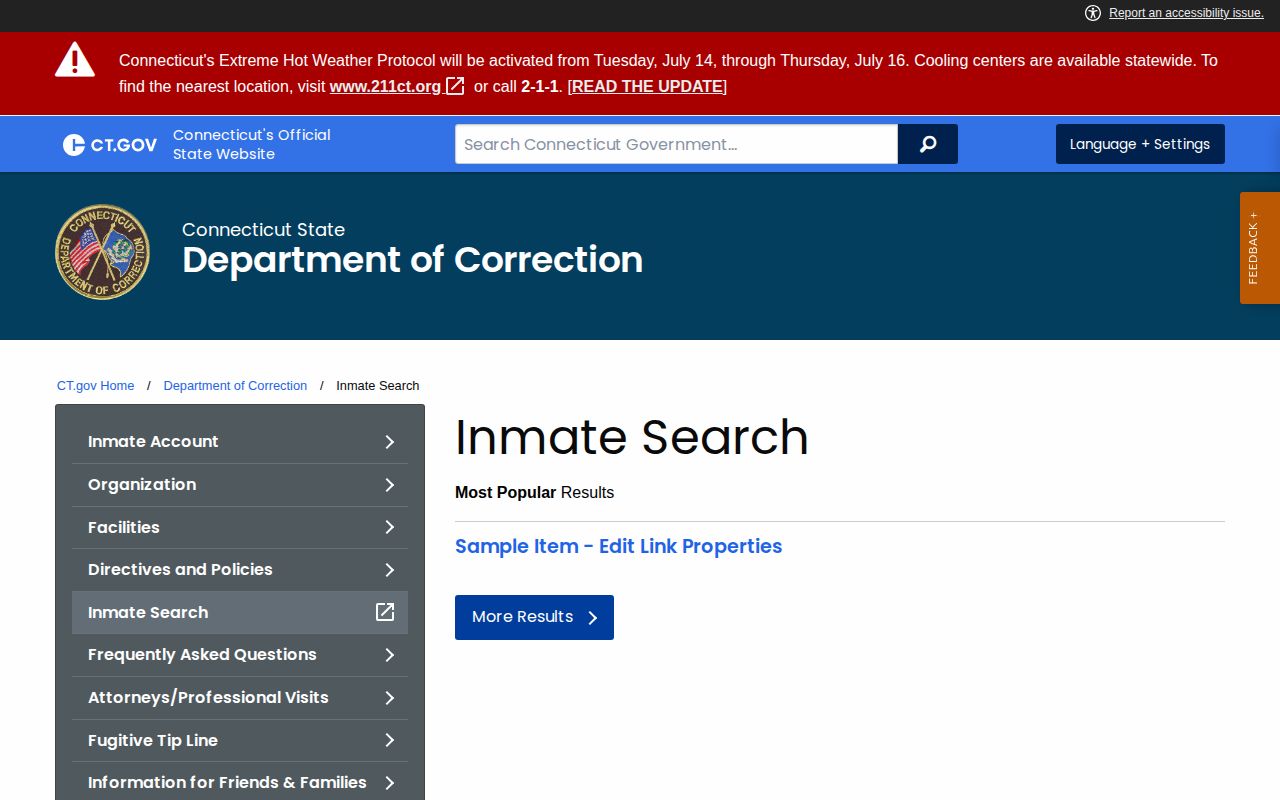
The search is built for current incarceration information, so a past discharge may require DOC records and court confirmation.
Waterbury DOC Release Date Fields
Waterbury's main release-date quirk is one of terminology. Readers often look for a single field called “projected release date,” but CT DOC lists minimum release date, maximum release date, and estimated release date. Read all three. The minimum and maximum dates mark different sentence boundaries, while the estimate reflects the agency's current calculation. The inmate record may also show admission and sentencing dates, the controlling offense, current location, a detainer, and whether the person is accused or sentenced.
| CT DOC field | What it helps explain | What it does not prove |
|---|---|---|
| Minimum release date | An earlier calculated sentence boundary shown by DOC | That release is guaranteed on that date |
| Maximum release date | The later sentence boundary in the current calculation | That no parole or lawful change can occur first |
| Estimated release date | DOC's present estimate based on the available calculation | The completed release event or exact release time |
| Detainer | A possible hold or claim by another authority | Release to the community after DOC custody ends |
| Accused or sentenced | Whether a final sentence supplies a calculation base | The case disposition by itself |
The CT DOC public FAQ identifies the available inmate information and date fields:
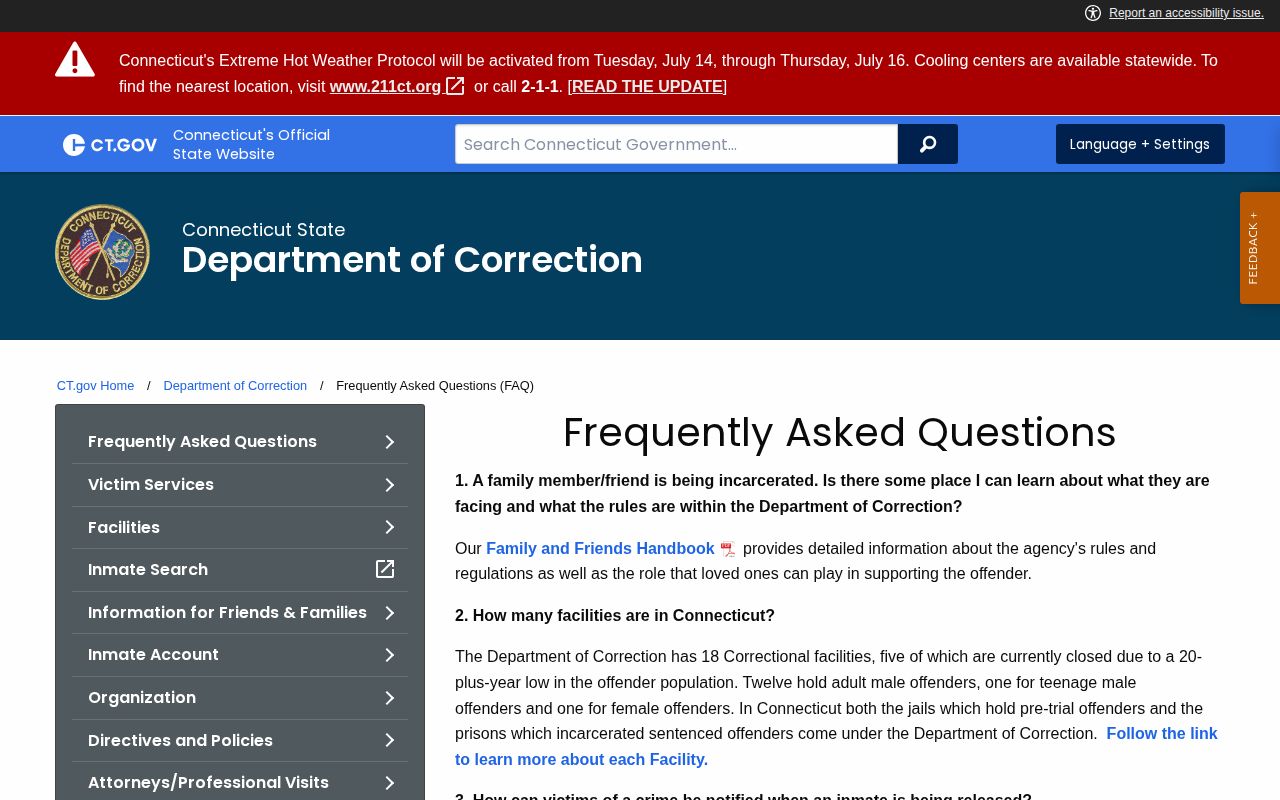
The field list provides the correct terms, while the person's live record and agency confirmation provide the current values.
Note: A displayed date should be saved with the date checked because CT DOC calculations and custody facts can later change.
Waterbury Earned Credit and Parole
The court sentence is the legal starting point, but CT DOC administers the custody calculation. Presentence confinement credit can account for eligible time already spent held before sentence. Earned risk reduction credit is governed by Conn. Gen. Stat. Sec. 18-98e. Those credits may affect a calculation or parole eligibility where the law permits. They are not a release order, and the public should not attempt to compute an exact day from a sentence length alone.
Parole eligibility is also separate from release. Under Conn. Gen. Stat. Sec. 54-125a, many nonviolent sentences may reach parole consideration after a 50-percent framework, while violent-offense categories generally use an 85-percent framework and some offenses are excluded. Risk reduction credit can affect the eligible calculation in defined cases. Yet the Board of Pardons and Paroles must still decide the case. Fifty or 85 percent never means automatic release.
A Board grant can lead to release under conditions. A denial, deferral, rescission, or case that never becomes eligible can leave the custody date unchanged or require a later review. BOPP's hearing calendar shows dated proceedings, but no full public name-search decision database was identified. Use the hearing material, CT DOC status, and agency records together.
- Presentence credit
- Eligible time in confinement credited toward the court sentence.
- Earned risk reduction credit
- A statutory credit administered under Connecticut law for eligible people and conduct.
- Parole eligibility
- The point when the Board may consider release, not an order to release.
- Maximum expiration
- The end boundary of the term as lawfully calculated, subject to the governing record.
Why Waterbury Release Dates Change
A release date can move for more than one reason, and the direction is not always predictable from the public record. Some factors change sentence credit. Others block release to the community even when CT DOC custody would otherwise end. Court orders can revise the legal base, while parole decisions can create a conditional release route. Compare the changed field with the docket and agency record before drawing a conclusion.
| Factor | Possible effect | Where to verify |
|---|---|---|
| Presentence confinement credit | Changes credited time in the calculation | Court sentence and CT DOC calculation records |
| Earned credit or discipline | May alter the estimated date or eligibility | CT DOC record and applicable statute |
| Detainer or outside hold | May lead to transfer rather than community release | CT DOC, court, and the agency lodging the hold |
| Court order or sentence change | Can alter the term, bond status, or basis for custody | Waterbury criminal docket and clerk record |
| Parole Board action | May grant, deny, defer, or affect conditional release | BOPP hearing and decision records |
| Facility or jurisdiction transfer | Ends custody at one location but not total custody | CT DOC movement history, BOP, or ICE |
Waterbury Pretrial Release Dates
A person held at New Haven Correctional Center for a Waterbury case may be in state custody but still be accused and unsentenced. The release question then turns on the court. A bond change, promise to appear, dismissal, nolle, time-served resolution, or other order can end the hold. A mittimus, which is the court's authority for commitment, can also explain why custody continues or changes.
Use the Waterbury GA 4 or Judicial District criminal record to find docket entries, bond, disposition, and sentence documents. Pair that record with CT DOC and VINE because the docket explains the legal event while the custody source shows whether the person actually left. A court date is not a release date. Likewise, an inmate's disappearance from the current CT DOC search is not enough to prove release.
For a person released directly from Waterbury Police before DOC admission, request police arrest and release paperwork through the Records Division or GovQA. That short event may never create the CT DOC date fields used for sentenced inmates. No Waterbury sheriff jail or county release calendar exists to fill that gap.
Note: Ask the records office for the exact custody and release documents, not a projected date that the agency never calculated.
Waterbury Weekend Release Rule
Connecticut has a release-date logistics rule titled “Expiration of term on Saturday, Sunday or legal holiday” in Conn. Gen. Stat. Sec. 18-92. That title signals that calendar placement can affect sentence-expiration handling. It should not be converted into an assumed pickup time or a promise that every person leaves early. Read the current statutory text and confirm its application with CT DOC for the specific sentence.
Facility logistics are also separate from the legal date. New Haven Correctional Center serves Waterbury courts but is in New Haven. CT DOC does not state a universal public release hour in the captured sources. Families should confirm the facility, lawful release status, and pickup instructions directly, especially near a weekend or holiday. A date field cannot answer where a person exits or whether another agency takes custody.
Confirm a Waterbury Actual Release
Use the date field to plan, then use the status records to confirm. Connecticut VINE can report a custody-status change and can send notice when the participating system updates. The court docket supplies the bond, dismissal, sentence, or order behind a Waterbury release. CT DOC maintains the state custody and movement history. If parole applies, BOPP and supervision records show that the person left prison under conditions rather than by full discharge.
The Waterbury VINELink release check explains how to follow one person's status and register for notices. A VINE result saying released does not mean the case ended, supervision ended, or no other agency holds the person. Confirm federal dates in the BOP locator and immigration detention through ICE, without blending either system into Connecticut's sentence calculation.
When the public CT DOC search no longer shows enough history, use the DOC Freedom of Information office. Ask for records sufficient to show admission, CT DOC number, facilities, movement history, release or discharge date, and release type for the named person and date range. That request seeks the actual agency record rather than reconstructing a date from old estimates.